
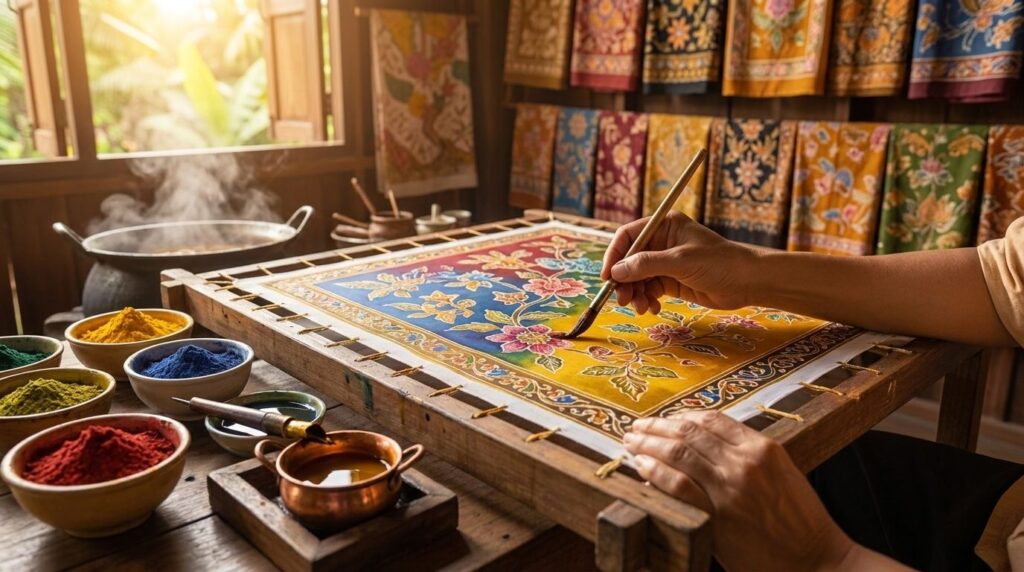
Most people who book a batik class Phuket workshop with us have never heard the word “batik” until three days into their holiday, usually when the forecast turns grey. Then, 2.5 hours later, they finish a hand-painted piece they made themselves (we fix and dry it, and they collect it about 2 hours after the class), slightly amazed that it worked. This article walks through exactly what happens in the class, minute by minute, so you know whether it’s for you before you spend ฿1,200.
Quick context: batik is a wax-resist dyeing technique. Southern Thailand has its own tradition of it — you’ll see batik sarongs all over the markets in Phuket Town — and the local style leans toward sea life, hibiscus flowers, and bright tropical colours rather than the geometric patterns you might know from Indonesia. The class we arrange is taught by a local artist who has been doing this longer than some of our customers have been alive, and no, you don’t need any drawing ability. More on that below.
The 2.5 Hours, Step by Step
Minutes 0–15: Choosing Your Design
You start by picking a design. There’s a folder of outlines — sea turtles, elephants, hibiscus, longtail boats, coral reef scenes — and the design gets traced lightly in pencil onto a piece of white silk stretched on a wooden frame. If you’re feeling brave you can draw your own freehand, and about one in ten guests does. The rest trace, and their finished pieces look just as good. Nobody is judging your pencil skills; the wax and dye do the heavy lifting.
Kids usually go for the turtle. Adults usually say they’ll do something “simple” and then choose the most complicated reef scene in the folder. Both approaches end fine.
Minutes 15–45: The Wax Pen (the Part That Needs Concentration)
This is the actual batik part. You get a canting — a small copper pen with a reservoir of melted wax — and you trace over every pencil line with a thin stream of hot wax. The wax soaks through the silk and forms a barrier. Later, when you paint dye inside a wax outline, the colour spreads out to the wax line and stops dead. That’s the whole trick: the wax is a fence, the dye is a very enthusiastic dog.
Honest notes on this stage:
- The wax is hot, around 60–70°C. It stings for a second if you drip it on your hand; it won’t injure you. Children from about age six manage fine with a bit of supervision.
- Wobbly lines are normal. Everyone’s first ten centimetres look shaky, and then your hand settles. On the finished piece, wobbles read as “handmade,” not “mistake.”
- If you leave a gap in a wax line, dye will escape through it into the neighbouring section. The teacher walks around checking for gaps before anyone touches dye, so leaks are rare — and even a leak just becomes a colour blend.
Minutes 45–120: Painting the Dyes (the Part Everyone Loves)
Now the fun part. You get pots of liquid dye — blues, greens, oranges, pinks, purples — and soft brushes, and you paint inside your wax outlines. Because the silk is damp-absorbent, the dye flows and blends on its own. Touch a loaded brush to the middle of a turtle shell and the colour blooms outward. Add a second colour at the edge and they merge into a gradient you could never plan.
This is the stage where the room goes quiet. It’s genuinely meditative — the same reason adult colouring books had their moment, except at the end you own a piece of painted silk instead of a torn-out page. The teacher demonstrates shading tricks (wet-on-wet blending, salt sprinkled on wet dye to create a starburst texture) and then leaves you alone unless you want help.
You have over an hour here, which sounds long and never is.
Minutes 120–150: Final Touches, Then We Finish the Piece
Once you’re done, the teacher checks your piece and we take over the finishing: fixing the colours so they won’t wash out, removing the wax and drying. That takes about 2 more hours after the class, so you come back to collect your piece, or we can arrange delivery. It rolls up to nothing in a suitcase, and back home it works framed, as a wall hanging, or as the most personal souvenir anyone in your family brings back.
Some guests later have theirs mounted or sewn into a cushion cover. One Russian family who did the class with us has come back three years running; their hallway is apparently now a gallery.
Who This Class Actually Suits
We tell people honestly when an activity isn’t for them, so here’s the same honesty in reverse — this one has an unusually wide range:
- Families. It’s one of the few Phuket activities where a 7-year-old, a teenager, and a grandmother are all genuinely occupied for the same 2.5 hours. Teenagers, who arrive glued to a phone, tend to be the most absorbed by the end.
- Rainy days. From May to October, Phuket gets afternoon downpours, and every boat-tour desk on the island gets the same panicked “what do we do today?” question. This is our standard answer. Indoors, air-moving, dry.
- Non-swimmers and the boat-weary. Plenty of visitors don’t swim, get seasick, or are simply islanded-out by day five. This is a real cultural activity that involves zero sunscreen.
- Anyone who got too much sun yesterday. You’d be surprised how often this is the actual booking reason.
Who it doesn’t suit: toddlers under about five (hot wax, patience required), and anyone who wants adrenaline. This is the opposite of a jet ski.
What to Wear and Bring
- Wear clothes you don’t love. The dyes are fabric dyes — that’s their entire job. Aprons are provided and they catch most of it, but a stray brush flick happens. Dark shorts and a t-shirt are ideal; the white linen holiday outfit is not.
- Bring nothing else. Silk, wax, dyes, brushes, aprons, and drinking water are all included in the ฿1,200 price (as of 2026). Some guests bring reading glasses for the wax-pen stage — genuinely useful tip if you use them.
- Cameras welcome. The teacher is used to being filmed and the work-in-progress shots are half the fun.
Class times are typically morning (around 10:00) and afternoon (around 14:00), and because it’s a small studio, groups stay small — usually two to eight people. If you have a bigger group, a family celebration, or a specific date, message us and we’ll arrange it directly with the artist.
Is ฿1,200 Fair? Our Honest Take
For 2.5 hours of instruction, all materials, and a finished silk painting you keep, we think it’s one of the better-value activities on the island — it costs less than most 30-minute jet ski rentals and you leave with something that lasts. If you’re comparing: some hotel-run craft sessions charge more for a shorter class using cotton instead of silk. We’ll always tell you if a cheaper equivalent exists; in this case, we haven’t found one we’d put our name on.
It also pairs well as a half-day: batik in the morning, then an easy afternoon nearby — ask us and we’ll sketch out a plan. Plenty of guests combine it with a relaxed south-island day.
FAQ
Do I need any artistic skill to do a batik class in Phuket?
No. Designs are traced from templates, the wax pen only requires a steady-ish hand, and the dyes blend beautifully on their own. First-timers regularly produce pieces that look professionally made.
How long does the batik workshop take, and when do I get my painting?
The full class runs about 2.5 hours (the colour painting class takes about 1 hour). After the class we fix the colours, remove the wax and dry your piece, which takes about 2 more hours, so you collect it afterwards or we can arrange delivery.
Is the class suitable for children?
From about age six, yes, with light supervision at the hot-wax stage. It’s one of our most-booked family activities, especially in the rainy season.
What does the ฿1,200 price include?
Everything: silk, wax, dyes, brushes, apron, instruction, and water (as of 2026). There’s nothing extra to pay at the studio. Hotel transfer can be arranged separately if you’re staying outside the Chalong area — ask us for the honest cost first.
Book a Spot (or Just Ask Us If It’s Right for You)
WhatsApp us at +66 93-687-1999 with your preferred date and group size — we’ll confirm with the artist the same day, and if the class isn’t the right fit for your group, we’ll say so and suggest something that is.
Or drop into our shop near the Chalong 5-way intersection. We keep a couple of finished batik pieces on the wall so you can see exactly what you’d be making before you commit a single baht.
Chang Thai Tour and Travel is a family-run, TAT-licensed agency (License No. 34/03373) in Chalong, Phuket.